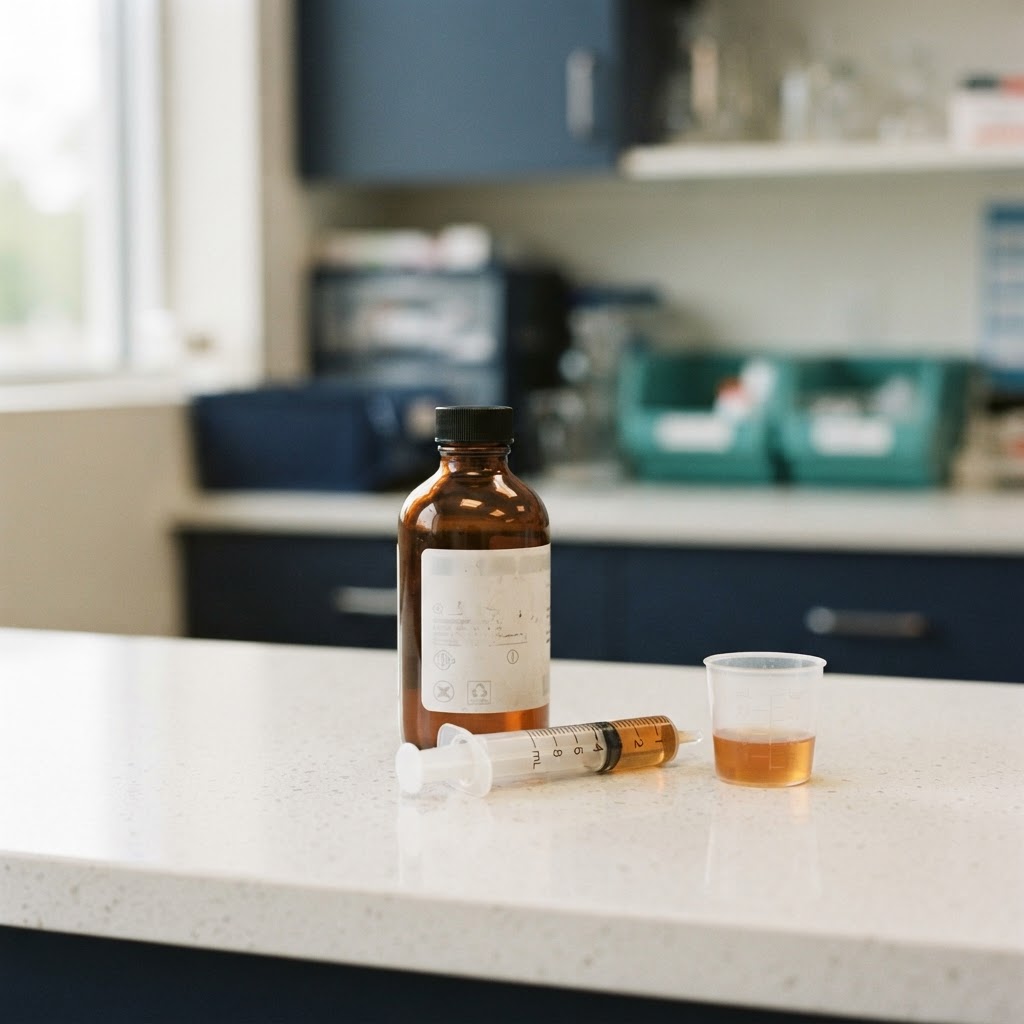
Measuring Liquid Medicine: Read the Label, Then Match the Tool
Understand liquid medication labels, concentration changes, and oral syringes so you can ask the right questions before measuring a dose at home.
A liquid prescription can look straightforward until you are holding the bottle in one hand and a measuring device in the other. Which line is correct? Does the old syringe still work? What if the label looks different from the last refill? Those are questions to resolve before giving the medicine. This guide explains the information to check; it does not calculate or recommend a dose for you or your child.
Separate the amount of drug from the volume of liquid
Milligrams, abbreviated mg, describe an amount of medication. Milliliters, abbreviated mL, describe a volume of liquid. A concentration connects the two: it tells you how much medication is contained in a stated volume. They are not interchangeable units. Some liquid medicines come in more than one concentration. The American Academy of Pediatrics warns that different strengths can lead to dosing mistakes.[1] The familiar medicine name is not enough to establish that the same volume is appropriate. At pickup, ask the pharmacist to identify three things on the current label: the medication, its concentration, and the volume prescribed for each dose. If the directions use a unit your measuring device does not show, ask for clarification rather than attempting a conversion yourself.
Use a medicine-measuring device
Kitchen spoons vary in size and should not be used to measure medicine. MedlinePlus recommends a calibrated device and notes that oral syringes are particularly useful for accurate measurement.[2] The device should fit the prescribed volume and have markings you can read. A very large device can make a small amount difficult to measure; a very small device may require repeated fills. AAP recommends asking for a tool suited to the dose and favors mL measurements.[1] Do not assume a syringe from an old prescription has the same scale. Keep the appropriate tool associated with its medicine, and ask how to clean and store it.
Ask for a demonstration you can repeat
Have the pharmacist show you the prescribed mark using the actual device. Then demonstrate it back so misunderstandings can be corrected before you leave. AAP specifically recommends this show-and-check approach.[1] Questions worth asking include: "Which edge of the plunger do I line up?" and "What should I do if the marking becomes hard to read?" If another caregiver will give doses, ask for instructions that person can follow too. A clear written plan is easier to share than a memory of a hurried conversation.
Check handling directions as well as the number
Suspensions generally need shaking so the medicine is distributed through the liquid; follow the directions for the actual preparation.[2] Also check storage instructions and the discard or beyond-use date printed on the container. These are separate questions from how much to measure. At each refill, compare the current instructions with the routine you have been following. If anything differs, ask whether the concentration, prescribed amount, device, or handling instructions changed. Do not carry an old measuring habit forward when the new label is unclear. For questions about a child's prescription, visit Sierra's Pediatric Compounding service page. Bring the bottle and measuring tool to the discussion so the pharmacy can address the preparation actually being used.
This article is general medication-safety education. Follow the current prescription and resolve unclear instructions with the dispensing pharmacist or prescriber before administration.
References
- 1. American Academy of Pediatrics Council on Quality Improvement and Patient Safety. How to Use Liquid Medicines for Children. HealthyChildren.org. Updated February 21, 2024. https://www.healthychildren.org/English/safety-prevention/at-home/medication-safety/Pages/Using-Liquid-Medicines.aspx
- 2. MedlinePlus Medical Encyclopedia. Liquid medication administration. Reviewed October 1, 2025. https://medlineplus.gov/ency/article/002209.htm
- Sources accessed October 7, 2026. Access date is not a source publication date.
Sierra Compounding Pharmacy Can Help
All compounded medications require a valid prescription from a licensed healthcare provider. If your provider has determined that a customized compounded formulation is appropriate for your needs, Sierra Compounding Pharmacy — located in Rancho Cucamonga — is here to help. We serve patients throughout the Inland Empire, including San Bernardino County, Riverside County, and surrounding communities.
Related Education Articles

When a Child Has Trouble Swallowing Pills
Questions to ask when a child has trouble taking pills, including prescription liquids, ingredients and pharmacist instructions.

What Does the Beyond-Use Date on Your Compounded Medicine Mean?
Understand a compounded medicine's beyond-use date, why storage instructions matter, and what to ask before using medicine left from an earlier fill.

Compounded Medication Forms
Understand common compounded dosage forms and the questions to ask about a prescribed capsule, liquid, topical or troche.
Questions About Compounded Medications?
Sierra Compounding Pharmacy serves patients and providers throughout the Inland Empire. Contact us or ask your provider to send a prescription directly.