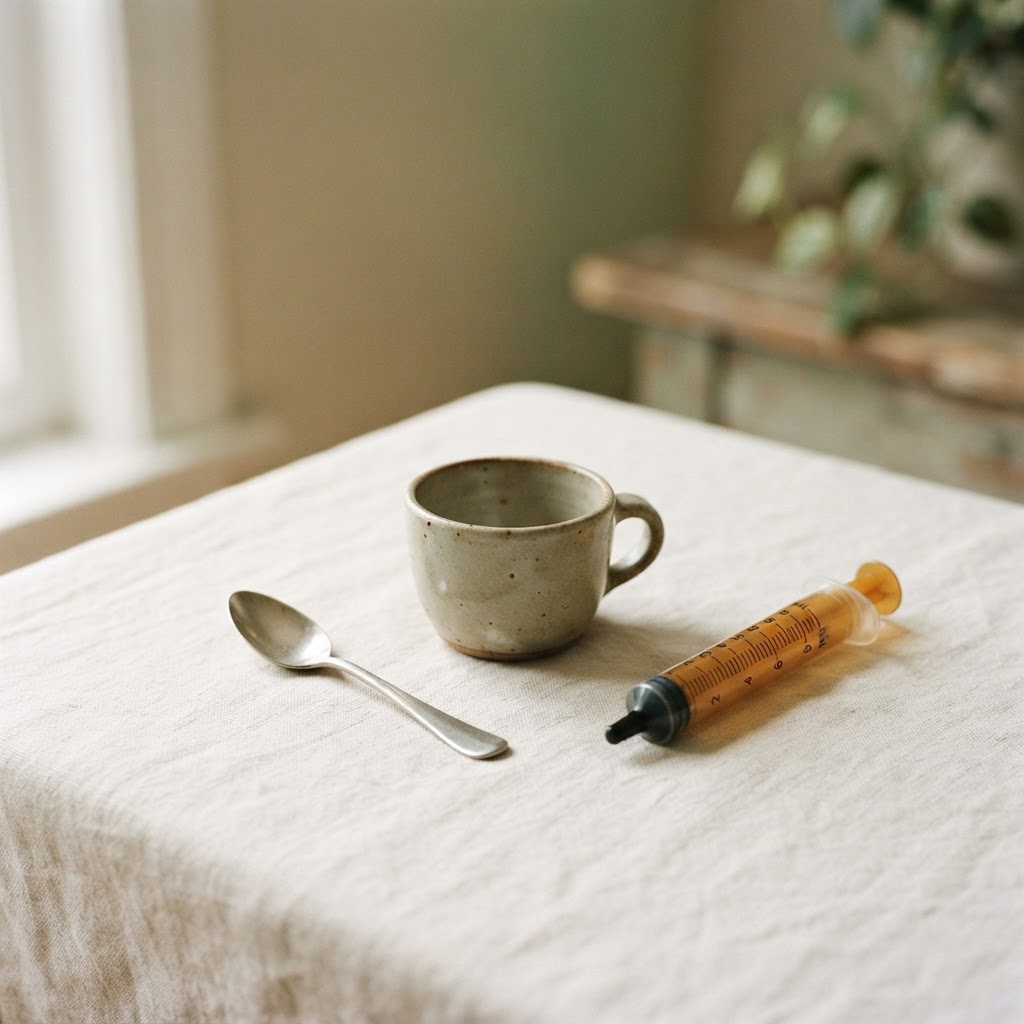
Can You Mix Your Child's Medicine With Food or a Drink?
Learn what to check before mixing a child's medicine with food, why a full bottle can cause dose uncertainty, and when to ask about another formulation.
Your child refuses a medicine, and mixing it into a favorite drink seems like an easy solution. Sometimes a pharmacist can recommend that approach. Sometimes the medicine, food, or dosage form makes it unsuitable. Check the exact prescription before mixing, crushing, or opening anything.[1,2] The goal is not merely to hide the taste. It is to give the prescribed medicine reliably, in a way that preserves its intended use and lets you know the dose was taken.
Ask about the specific medicine and food
Medicines for Children advises checking with a pharmacist or clinician before mixing liquid medicine into a drink, because the method is not appropriate for every medicine. It also advises confirming whether a tablet can be crushed rather than assuming that it can.[1,2] A useful question includes the medicine name, formulation, and proposed food: "Can this liquid be mixed with this drink, and what amount should I use?" A general answer about one child's antibiotic does not establish what is suitable for another prescription. If you have already tried a method, describe exactly what you did. The pharmacy needs that information to help, not a perfect account of how the dose was supposed to be given.
Why a full bottle creates a problem
For babies whose medicine can be mixed with milk or feeds, Medicines for Children advises using a small amount and never adding it to a full bottle. If the child does not finish the bottle, the amount of medicine swallowed is uncertain. The guidance also says to prepare the permitted mixture immediately before giving it, rather than ahead of time.[3] Ask the pharmacist to specify a suitable small amount for your child and prescription. Do not turn this principle into a universal mixing recipe: the permitted food or drink and the medicine's instructions still come first. Imagine a child drinks half a cup containing a dose and refuses the rest. You cannot confidently conclude that half the medicine was taken. Do not estimate a replacement dose from the amount of drink remaining; ask for advice about the exact medicine and what happened.
Keep the original bottle unchanged
Permission to mix one measured dose does not mean permission to add juice, syrup, flavoring, or extra water to the entire medicine bottle. That changes what is being measured and can make subsequent doses unreliable. If flavor is the problem, ask the pharmacy whether an appropriate formulation or flavoring option exists. Do not modify the dispensed preparation yourself. Be specific about whether your child dislikes the taste, struggles with swallowing, gags at the volume, or refuses the dosing device. Those are different problems to solve.
Do not make the next dose a guessing exercise
Before leaving the pharmacy, ask what to do if your child spits out medicine, vomits after a dose, or does not finish an approved mixture. Request medicine-specific instructions rather than a general rule to repeat every lost dose. When caregivers share responsibility, record the product, time, and amount actually given, plus any uncertainty. "Offered at 8 a.m.; some was spat out; advice requested" is more informative than marking the dose complete.
When a different formulation may be discussed
Compounding may be considered for an individual medical need when a suitable manufactured preparation does not meet that need. Compounded drugs are not FDA-approved, and a new formulation still requires clear directions and professional review.[4] Visit Sierra's pediatric compounding page to discuss a prescribed medicine that is difficult to administer. Bring the current label and explain the specific obstacle so the pharmacist and prescriber can assess available options. This article provides general education, not instructions for mixing or repeating a particular child's dose.
References
- 1. Medicines for Children. How to give medicines: Liquid medicine using an oral syringe from a bottle with a bung. https://www.medicinesforchildren.org.uk/advice-guides/giving-medicines/how-to-give-medicines-liquid-medicine-using-an-oral-syringe-from-a-bottle-fitted-with-a-bung/
- 2. Medicines for Children. How to give medicines: Tablets. https://www.medicinesforchildren.org.uk/advice-guides/giving-medicines/how-to-give-medicines-tablets/
- 3. Medicines for Children. Medicines information booklet; Mixing liquid medicines with milk or feeds. https://www.medicinesforchildren.org.uk/wp-content/uploads/sites/8/2024/02/Medicines-booklet-A5-20-pages-for-print.pdf
- 4. U.S. Food and Drug Administration. Understanding the Risks of Compounded Drugs. https://www.fda.gov/drugs/human-drug-compounding/understanding-risks-compounded-drugs
- Sources accessed November 2, 2026. Access date is not a source publication date.
Sierra Compounding Pharmacy Can Help
All compounded medications require a valid prescription from a licensed healthcare provider. If your provider has determined that a customized compounded formulation is appropriate for your needs, Sierra Compounding Pharmacy — located in Rancho Cucamonga — is here to help. We serve patients throughout the Inland Empire, including San Bernardino County, Riverside County, and surrounding communities.
Related Education Articles

When a Child Has Trouble Swallowing Pills
Questions to ask when a child has trouble taking pills, including prescription liquids, ingredients and pharmacist instructions.
Measuring Liquid Medicine: Read the Label, Then Match the Tool
Understand liquid medication labels, concentration changes, and oral syringes so you can ask the right questions before measuring a dose at home.
Children's Cold Medicines: Read the Ingredients Before the Brand
Learn how age restrictions and overlapping ingredients affect children's cough and cold medicines, and what to ask before giving another product.
Questions About Compounded Medications?
Sierra Compounding Pharmacy serves patients and providers throughout the Inland Empire. Contact us or ask your provider to send a prescription directly.